




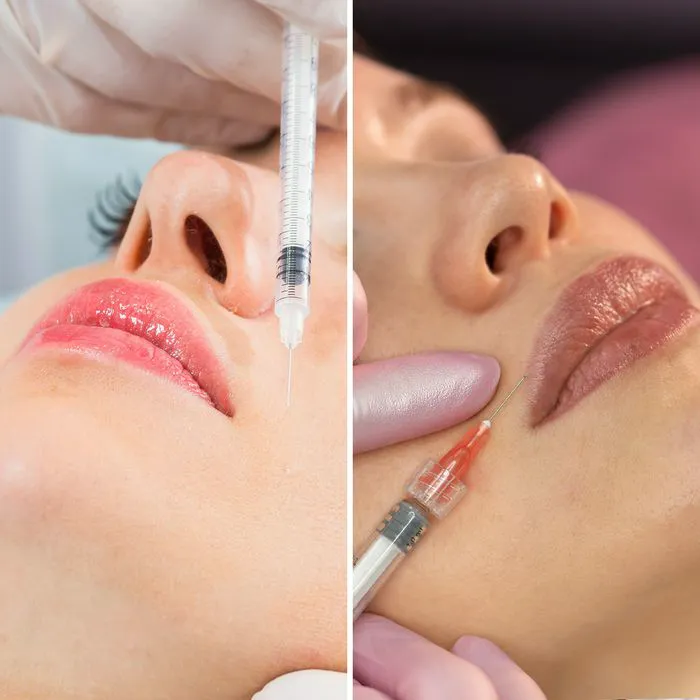
If you’re thinking about refreshing your appearance with injectable treatments, you’ve likely come across Sculptra and hyaluronic acid (HA) fillers. While they’re often grouped together, they actually work in completely different ways.
According to Dr. Luis Soro, choosing between the two isn’t about which treatment is better—it’s about what your skin needs.
“My answer to that is really person-dependent,” Dr. Soro explained in a recent video. “Every individual has different needs.”
Here’s how the two treatments compare.
View this post on Instagram
Hyaluronic Acid Fillers: Best For Instant Volume
If your main concern is volume loss—such as hollow cheeks, sunken temples, or deep facial folds—Dr. Soro says hyaluronic acid fillers are typically his first choice.
“If I’m looking to replace lost volume, areas that have noticeable lipoatrophy or sunkenness in the face, then I’m typically choosing a hyaluronic acid filler that’s going to immediately replace volume, lift things,” he said.
Unlike collagen-stimulating treatments, HA fillers provide instant results, making them ideal for patients who want noticeable improvement right away.
Dr. Soro also points out several advantages:
- Immediate volume restoration
- Helps lift facial features
- Softens deeper lines and folds
- Safe and predictable
- Reversible if needed
“Nothing compares to it,” he said. “Very easy to use, very safe—it’s also reversible.”
Sculptra: A Slow, Collagen-Boosting Treatment
While fillers work by adding volume immediately, Sculptra takes a completely different approach.
Rather than filling an area, Sculptra contains tiny particles that stimulate the body’s own collagen production over time.
“Sculptra is a very slow, gradual process,” Dr. Soro explained. “It’s doing something totally different from hyaluronic acid filler.”
Instead of seeing instant changes, patients typically notice improvements gradually over weeks to months.
As collagen production increases, Dr. Soro says patients may experience:
- Thicker-looking skin
- Smoother fine lines
- Improved elasticity
- Firmer skin that’s less prone to sagging over time
He also notes that Sculptra encourages elastin production, another important protein responsible for skin’s bounce and flexibility.
“Gradually over time you’re seeing this nice effect to thicken the skin, smooth out fine lines, improve overall elasticity, so it’s less likely to sag over time,” he said.

Women Are Swapping Their Boring Water For This Ice Pop Electrolyte Mix!

Can You Have Both?
According to Dr. Soro, many patients actually benefit from combining the two treatments.
Hyaluronic acid fillers can restore volume where it's been lost, while Sculptra works behind the scenes to strengthen and improve skin quality over the long term.
"They can likely benefit from both things," he explained, "but each individual may just need one or the other."
The Bottom Line
Although both treatments are injectable, they serve different purposes. If you're looking for immediate lifting and volume, hyaluronic acid fillers may be the better option.
If your goal is to gradually rebuild collagen, improve skin texture, and increase firmness, Sculptra may be a better fit. The best treatment ultimately depends on your facial anatomy, skin quality, and long-term goals, making an individualized consultation the most important step before deciding between the two.